Who are you?
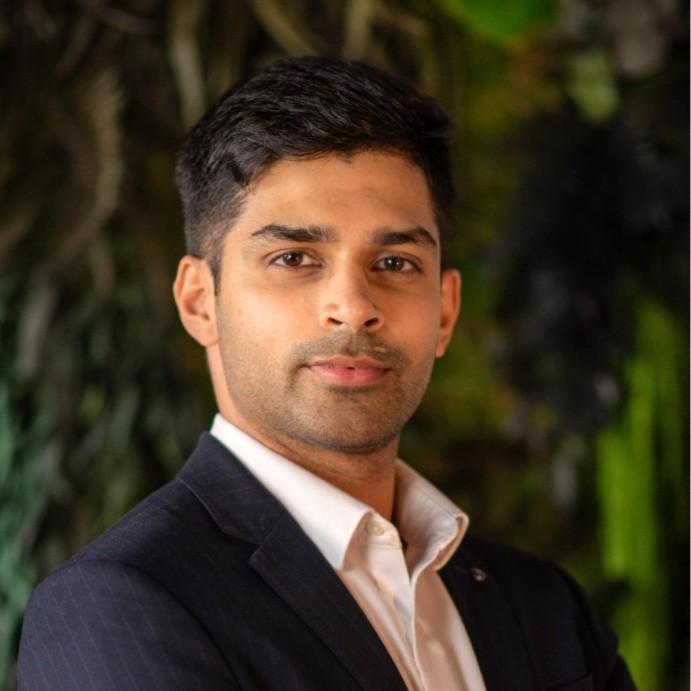
My name is Niranjan Raghavan. I'm from India, and I graduated from the Master of Science & Technology program in Energy Environment: Science, Technology and Management (STEEM) at Ecole Polytechnique in 2019. This specialization covers the full energy sector from the ground up: the physics of solar and wind, project development, and all the way through to investment structuring and project finance. Today I'm the Sustainable Finance Lead at AXA Climate, where I work with private equity funds, impact investors, and banks on climate risk, insurance, and adaptation services.
Why did you choose Ecole Polytechnique?
I was living in the US and had already completed a master's there, but I knew I wanted to build my career specifically around climate and energy transition. 2018 was shortly after the Paris Agreement, and France felt like the place where that work was being taken most seriously. Once I decided on France, the choice of institution was straightforward — I had known about Ecole Polytechnique since high school. The history, the technical rigour, the calibre of people who had come through its doors. It was the only application I submitted in France. When they called, there was no other option I was even considering.
How did you adapt to life in France?
I arrived knowing exactly four words of French. I'm still not entirely sure what I was thinking — but the reasoning was simple: if I don't take this opportunity at 26, I won't get it at 40 or 50. That was enough to make me pack my bags.
The cultural shift was real, but it turned out to be a deeply enriching one. Learning to work in French reshaped how I think professionally. French business culture demands a particular kind of rigour — you're expected to anticipate counterarguments, examine a problem from every angle before presenting a position. Over time I found myself applying that analytical discipline even when working in English. Seven or eight years in, I think of it as a productive alter ego: two distinct professional registers, each sharpening the other.
I came in on the Make Our Planet Great Again scholarship, launched by President Macron in 2018 to attract global climate and energy talent to France following the Paris Agreement. The scholarship, the institution, and the moment all came together at once — it felt like everything aligned.
What skills from the program are you using today?
The defining feature of STEEM is that it's genuinely end-to-end. You go from technical engineering — how a PV panel works, how to model an energy system — all the way through to financial modeling, project economics, and investment logic, with faculty drawn from HEC and other institutions alongside Polytechnique's engineers. At the time I leaned toward the technical side, assuming that was where my value would lie. What I've learned since is that the combination is the thing.
In every role I've held — consulting, venture capital, M&A, and now at AXA Climate — the gap I keep finding is the same one: technical people struggle to do rigorous financial analysis, and financial people don't understand the underlying technology well enough to evaluate it properly. I sit exactly in the middle of that gap. It's sometimes a lonely place to be, and sometimes a uniquely powerful one — often the only person in the room who can hold both ends of the conversation at once. That is, concretely, what this program built.
What are your best memories of Ecole Polytechnique? The cohort, without question. Around 30 to 35 nationalities in a class of 50 — a mix I hadn't encountered anywhere before. I'm still in regular contact with 35 to 40 of those classmates. Each one brought something genuinely different to the table, and some of them I was still discovering new things about by the end of the year. That combination of people — technically excellent, internationally diverse, each with their own particular streak of brilliance — was something I couldn't have assembled anywhere else.
Beyond the people, what that diversity taught me has stayed directly relevant to my work. Climate solutions aren't portable by default. What works for flood adaptation in France won't automatically work in Nigeria or Indonesia. Before you apply any framework, you have to understand the local context — ask what's actually needed on the ground, in that place, for those people. That instinct came directly from spending a year and a half working alongside people for whom the same problems looked entirely different.
What are your ambitions for the future? To keep doing work that sits at the intersection of technical depth and financial strategy in the climate space — and to keep growing on both sides of that equation. Looking back, the one thing I'd change about my time at Polytechnique is that I'd have taken more financial modeling courses earlier. I was already technically solid; a stronger finance foundation sooner would have made the combination complete even faster. That balance is what I'm continuing to build, and what I hope to bring to the people and institutions I work with going forward.