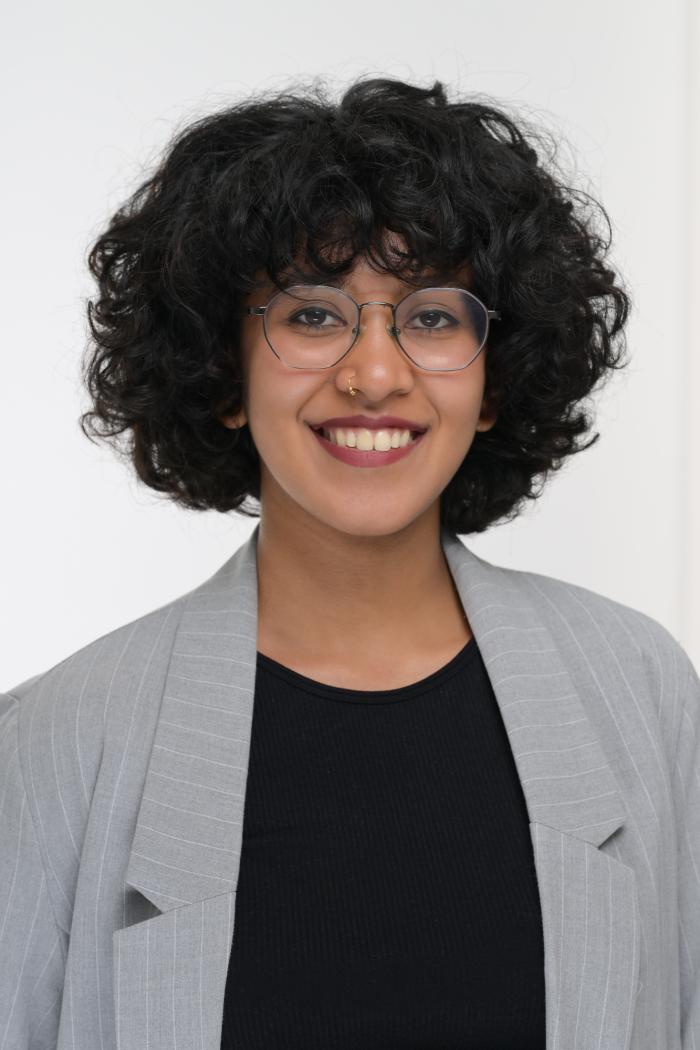
Who are you?
Hi, my name is Srishti. I am a first year MSc&T student here at Polytechnique in the Energy Environment: Science, Technology and Management (STEEM) specialization. I grew up in Dubai. I spent basically 19 years of my life there. Then I moved to Bombay to do a bachelor’s in chemistry, worked for two years in finance, and now I'm here.
Why Ecole Polytechnique?
I wanted to get into the domain of energy and environment and because I already have professional experience, I know how important it is to get as much experience as you can. You can’t truly understand industries until you're working in them. Polytechnique gave me the opportunity to work not only at the end of my masters, but also during with two internships. I knew it would give me a great experience, not just in terms of what I would learning, but also because of that professional experience. That was very unique about the program.
Tell us about your class.
We're an extremely international cohort. We're from pretty much everywhere. There are people from Mexico, Australia, America, India and so many countries. Something interesting about the student cohort is that pretty much all of us have come with professional experience. Some of us have worked in oil and gas. Some of us have worked in software engineering. I worked in finance. It’s a wide variety of domains that require a different sort of pool of skills and competences. But together we're also kind of learning the same thing. And we all bring a unique perspective to the whole program and specialization.
How is the campus life?
There's always something going on at Ecole Polytechnique. You just need to go out there and do it. We have the MoX (MSc&T student association) that hosts many different events: movie nights, Thursday cookout where you can get a cheap meal for like 2 or €3, which is crazy, and a bunch of other events. There's always something going around and since I stay on campus, I also have the added benefit. Anytime I go to cook or I just want company, I just go downstairs and there's going to be like ten people doing something somewhere.
Do you have a favorite course?
This is a bit of a weird answer, but I think my favorite course was Energy Environment, in the first semester and I wish it was a course that could be offered over multiple years. It's like doing an entire degree in energy and different types of energy: solar and wind and fossil energy… But imagine learning about every single type of energy in the span of three months. It gets a bit intense, but I think it was perfect to give me a great base into energy, especially because based on my background, I don't have much experience at all.
What projects do you have in class?
In Semester 2 I worked on a project for one of my courses called Projects and Solar and Wind Energy. The project is on solar spatial variations so basically analyzing the difference and solar potential as you change latitudes from the equator up to the poles. But that’s just for my part, there are people doing many other projects. For example, we have a lab around campus called CO2, which has its own PV modules available. There are groups that are analyzing the actual data from those modules. There are other groups that are analyzing wind potential in urban cities. There’s a lot of free reigns to focus on a project that you really want to do.
How important is Python in your field?
Python is essential. Polytechnique offers an introduction to Python course right at the beginning of the year. I took it and it's a great place to get started, but if you'd rather not take a full beginner course and just learn it in your own time. I highly recommend learning it because within STEEM and in my project I mentioned for the project, I was doing analysis of solar potential using Python and a lot of data. I think Python is an absolute must-have now so get comfortable with it as soon as possible.
Do you think it’s important to have a mixed education, not just in science?
Oh, I think it's super important. I have always been someone that strongly believes, even if you're studying science, you need to be able to have some basic knowledge of all the other fields, like humanities and languages and even management.
And again, this is science, technology, energy, environment management specialization so it is crucial to understand how the industry works and what really makes the industry move, because that's where you're really going to make change.
Do you get to go on academic field trips?
This is one thing that's very particular to STEEM and I'm so happy we had the opportunity. We had the opportunity to visit two different places in December 2025: the Schneider Smart, and a hydroelectric power plant in Gellert, run by EDF. One is in smart buildings, urbanization and overall smart technology and the other is in core energy business. It was an amazing experience. It gave you a great insight into two different ways you could use this degree. And I think it was one of those experiences that you don't really get to have very commonly. It very much made me realize I would love to be in like core energy work. I would love to do something like working on fees on feasibility studies, whether it's possible to have either PV panels or wind or hydro or something that tailors to specific locations and cities.
What background to integrate the STEEM specialization?
You need to have a great base in mathematics. If you are not comfortable with at least advanced calculus, it's going to be very difficult because a lot of the Steam program is engineering and physics. And even if you don't really have physics principles and engineering principles like me, you'll be able to keep up. If you had a good base in math, like I mentioned, my bachelors’ of in chemistry, which is completely unrelated to engineering. And of course it's not physics, even though a lot of people might say it is. But just because I had a very strong base in math, I'm able to with a bit of extra effort management studies, but physics, maths, engineering, I think those backgrounds are perfect.
What helped in the internship search?
Ecole Polytechnique. The easiest way and most useful way I used in finding my internship was Ecole Polytechnique very own job board, which you can use to apply for jobs. You have a lot of jobs available because alumni went already did internships there or companies that have a partnership or long history with Polytechnique. It's easier to get a foot in the door. Otherwise, we have the alumni association (AX) that also shares opportunities from their network. And every year, we also have the X-Forum where 50+ companies come meet us on campus. You can reach out and talk to them directly, speak to recruiters, give your CV… I think there are quite a few people who do find their internships using the X-Forum. Ecole Polytechnique do the best they can even if the job market can be challenging.